There is a document in which someone writes down how you make a regulator fight thin air. It is not a summary after the fact, not a journalist’s reconstruction. It is a proposal, written in November 2018, with options and risk levels. Option two was recommended. Option two was carried out.
Twenty to thirty percent
June 2019, a video meeting of the Binance leadership. Someone reports how much of the exchange’s traffic comes from one single country: twenty to thirty percent. The same share of the revenue.
The country is the United States. And that is exactly where the problem sits: Binance has no licence there. Not one.
Changpeng Zhao, founder and owner, weighs it out loud. “Blocking the US is probably one of the biggest business decisions we have to make,” he says. And then: “but it is better than losing everything.”
What happened next sits in four years of chat messages, recorded phone calls and internal documents that the American prosecutors and the securities regulator SEC laid out in the open in 2023. We have read all of them — 404 pages. This is part one.
“Better to ask for forgiveness”
Zhao already had a name for it. In a chat message from September 2019 he explains why Binance had never let go of the American market:
He called it a grey zone. His words, not ours.
And he was right about the money. Between August 2017 and October 2022 Binance earned $1,612,031,763 from American users. One and a half billion dollars, out of a country where the company was not allowed to operate.
If we blocked US users from day 1, Binance will be not as big as we are today. … better to ask for forgiveness than permission.Changpeng Zhao in an internal chat message, September 2019. From the indictment brought by American prosecutors.
The man with the three options
Back to November 2018. Binance hires advisers to map out the American problem. One of them runs a crypto trading firm in the United States himself. In the court records he is called only Binance Consultant.
He comes with a presentation. Three options, each with a risk label.
Option one, low risk: go to the regulators, talk, settle, resolve everything. His own advice attached: don’t. The settlement costs “could be significant” and it could lead to “the complete loss of the US market during the settlement process”.
Option three, high risk: leave everything as it is. Also a no — that invites enforcement, including an SEC case over “the issuance of BNB to U.S. persons” and the running of an “unregistered securities broker-dealer”.
Option two, medium risk. That was the one he recommended. And it deserves to be quoted word for word, because the wording leaves little to the imagination.
The target of all the tension
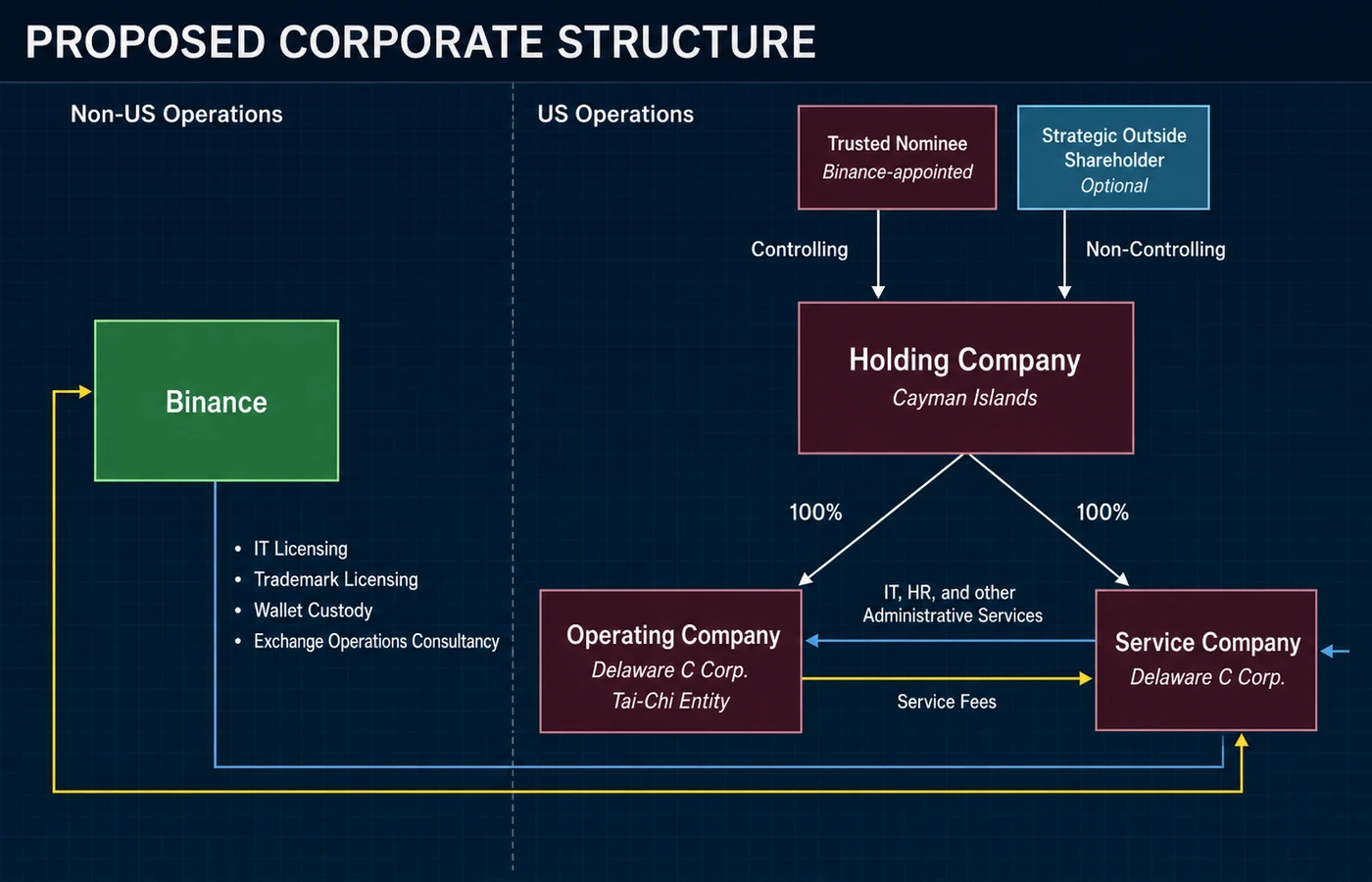
Set up an American entity, the consultant wrote. He had already given it a name: the Tai Chi entity. After the martial art in which you use your opponent’s force and move with it instead of blocking it.
That entity would “become the target of all built-up enforcement tension”. It would “reveal, delay and resolve” that tension. And, in one sentence that says everything: it would “insulate Binance from existing and future liabilities”.
After that it got practical. Binance had to present itself to the outside world as a supplier of technology, not as an owner — “by visualizing Binance as a technology provider”. The liquidity on the American platform would come from “affiliated or contracted market makers”. The licensing fees the American entity would pay were “functionally U.S. trading revenue”.
And then the two sentences you have to read twice. To shield Binance from American enforcement, “key Binance personnel should continue to operate from non-U.S. locations”. And the wallets and servers had to stay outside the US — “to avoid asset forfeiture”.
Talking to the SEC, with no expectation
The advice went further than structure. It also described a piece of theatre.
“Purely for publicity” the Tai Chi entity had to publish a long and detailed legal framework on the question of when a token is a security — to show “Howey test sophistication”, after the American standard test. Then it had to go and talk to the SEC about setting up or acquiring a broker-dealer.
With, literally: “without any expectation of success and solely to pause potential enforcement”.
And then the part that runs straight into what happens in part two. To make enforcement less attractive, Binance had to publicly “restrict U.S. persons’ access to the main site” — while customers were privately encouraged to get around that restriction, through what the consultant called the “strategic treatment of VPNs”. That kept the economic damage of the public announcement to a minimum.
In the long run Binance would buy the American operation back “at a nominal price” and replace its leadership — “once it has served its purpose”.
Zhao replies
What did Zhao say back? That is in the record too.
He said Binance had also spoken to American law firms that proposed a “more conservative approach” that was “probably safer for now”. But he was “still very keen” to keep working with the consultant.
And then this sentence: “There are elements from both of your proposals we may combine.”
He added something that gives away that both men knew what they were doing. Having a reputable law firm behind you, Zhao wrote, “reduces the personal exposure you take on as well”.
They had to “work as a team”.
There are elements from both of your proposals we may combine. … having [a U.S. law firm] behind us reduces the personal exposure you take on as well.Changpeng Zhao to the consultant, November 2018.
The video call of November 2018
There was more to it than an exchange of emails. There was also a conversation.
In early November 2018 Zhao’s personal assistant set up a video meeting between the consultant and the leadership. According to two people who were there, he presented the plan to Zhao directly. And Zhao agreed — for one reason: he did not want to lose the American customers.
About a week later Binance’s then chief financial officer, Wei Zhou, sent a message to the leadership. “We have started planning” the Tai Chi entity, he wrote. It needed a communications strategy to go with it, one that would win “hearts and minds” in the United States, with a message about compliance.
That is an important detail. The SEC later stated that the plan was carried out; Binance maintained it never got further than a proposal from an outsider. But in November 2018 its own chief financial officer was already writing that they had started.
In those same weeks the consultant set down what the execution would turn on. The American company had to “carefully preserve the technical separation from Binance” — to avoid having to admit that it was a “de facto subsidiary”. The revenue could simply flow to the main exchange, in the form of licensing and service fees, without putting the legal separation at risk.
The structure had to preserve the technical separation so the company would not have to admit it was a “de facto subsidiary”.From a message by the consultant to the leadership, November 2018 — reported by Reuters.
Nobody was allowed to say where the office was
To understand how a plan like that could take shape at all, you have to know how that company worked.
Staff were not allowed to say in public who they worked for or where they sat. Not on social media, not at a conference, and preferably no clothing with a logo on it either. In 2018 an American security firm simply asked for the address of the head office. After internal discussion Zhao gave the order to pass on an address in the Cayman Islands — where he had a holding company — while almost the entire workforce sat in Asia.
A manual for an encrypted chat service went round, circulated by Zhao’s assistant. Employees were on no account to sign up for it with their Binance email address. Listed as an advantage of the service: messages delete themselves.
On Slack, the chat app half of Silicon Valley runs on, Zhao was brief. That company would hand their data to any American agency “on a silver plate”. Slack itself says it only complies with valid legal requests.
At least four employees were uncomfortable with it. One former manager summed it up later: it felt like you were doing something wrong.
February 2019: the same address in San Francisco
And then the plan became a company.
In February 2019 a company was incorporated in Delaware under the name BAM Trading Services. The address given on the filing was the same address in San Francisco as that of the crypto trading firm of the man who had written the Tai Chi proposal.
In June 2019 BAM registered with the American Treasury Department as a money services business — in exactly the days when Binance announced it would bar American users from the main exchange. A few days later BAM was presented as the partner behind a new, separate exchange: Binance.US. Zhao called it “a fully independent entity”.
The regulatory filings show something else. BAM was ultimately owned by Zhao. The first CEO of Binance.US reported to a board chaired by Zhao. The holding company in the Cayman Islands held the digital wallets of the American customers. And on an internal org chart Binance.US simply appeared as part of the group.
There is one more detail that leaves little room. When the new American CEO was announced, Binance’s chief strategy officer wrote to staff that to the outside world she was a partner. And internally? Internally she was a valued team member.
To the outside world a partner. Internally a valued team member.From an internal announcement by Binance’s chief strategy officer, July 2019 — reported by Reuters.
“Binance implemented much of the Tai Chi plan”
That is not our conclusion. It is the SEC’s own finding, word for word, in its complaint of 5 June 2023 allegation. Binance flatly denied it at the time: the consultant had supposedly never been employed and the plan had supposedly never been carried out.
What is beyond dispute: on 13 June 2019 Binance announced a separate American platform, run by “our local partner”, that would serve the American market “in full compliance with the rules”. The next day, 14 June, the terms of use of the main exchange changed for the first time so that Americans were no longer allowed to trade there — with blocking “after 90 days”.
And on the day of that announcement the consultant circulated an internal instruction. Whatever you do, do not link the launch to the blocking of Americans on the main site, he wrote. Because that would suggest two things: that Binance knew it had been in violation before, and that the two companies were “alter egos of each other coordinating the work together”.
“Personally rejected”
There is someone else who saw it coming, and who wrote it down.
In December 2018 Zhao asked a lobbyist in Washington to talk to his chief financial officer about the American plans. The lobbyist explained that an American exchange would have to comply with the anti-money-laundering rules. The chief financial officer, he says, mostly wanted to talk about how fast Binance could grow.
Afterwards the lobbyist sent Zhao a letter warning him that the company seemed to care little about the American law against financial crime. He closed with a Chinese proverb: listen to both sides and you will be enlightened, listen to only one side and you will stay in the dark.
Almost four years later, when Reuters published the Tai Chi story, Zhao responded in a blog post. He had personally rejected the plan, he wrote. Binance.US had been set up on the advice of leading American law firms.
That is his version, and it belongs here. Against it: a video call in which, according to two people present, he agreed, a chief financial officer who wrote a week later that they had started, a company incorporated at the address of the man who drafted it, and an SEC that four years later found that much of the plan had been carried out.
29 October 2020
For almost two years the document stayed inside. Then it leaked.
On 29 October 2020 Forbes published a piece by journalist Michael del Castillo under a headline saying that a leaked “Tai Chi” document revealed an elaborate Binance scheme to evade crypto regulators. According to Forbes the author was Harry Zhou, a former Binance employee and co-founder of Koi Trading in San Francisco — a company that had received three million dollars from Binance’s venture capital arm and that shared the same address with the American Binance entity in incorporation filings.
Binance denied it, and sued Forbes and two journalists for defamation. The company later withdrew that case.
But inside its own American subsidiary the article landed hard. The CEO there wrote to Binance’s chief financial officer shortly after publication that her staff had “lost a lot of confidence because of the article” and that the whole team felt “they had been duped into playing a puppet”.
What went on inside that American subsidiary is the subject of part three. But first part two: what happened to the customers who, according to the announcement, were no longer allowed to exist.
Sources
This series is based on six court documents, all of which we read in full. For this part above all: the SEC complaint of 5 June 2023 (136 pages, case 1:23-cv-01599, D.C. — Tai Chi in ¶¶112-124) and the indictment by American prosecutors of 14 November 2023 (case CR23-178, Seattle). Also: the Forbes article of 29 October 2020. Quotations are taken from the court documents. The SEC case is a civil complaint — allegations, not proof. What is settled is the criminal guilty plea of November 2023; that is what part three is about. Current as of 1 August 2026. For the November 2018 video call, the secrecy rules, the incorporation of BAM Trading and Zhao’s response: the investigation by Tom Wilson and Angus Berwick for Reuters, 17 October 2022.