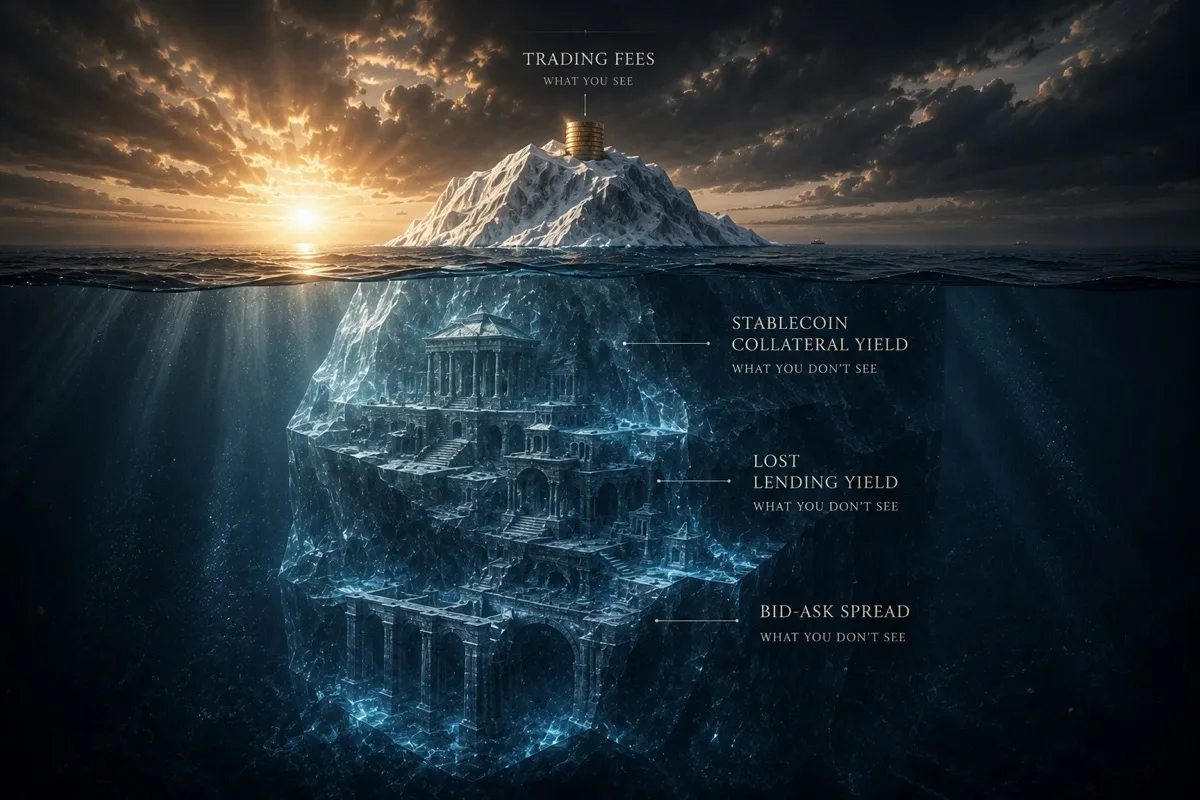
At traditional brokers and many crypto exchanges you pay fees to trade and earn zero interest on cash. Some modern exchanges combine both: you earn interest on your USDC/USD balance even while it serves as margin for open trades.
1. What is yield on collateral?
Yield on collateral means you automatically earn interest on your exchange cash balance. Crucially, the money is not locked — it simultaneously backs your trades.
This works because the untraded portion of your balance is lent out through the exchange's lending pool, and the interest flows back to you.
2. How does it work technically?
The exchange operates an internal lending system. Your USDC (or USD) is automatically placed in a pool where short-sellers and margin traders can borrow it. Interest from those borrowers flows back to you.
As soon as you open a position, the used portion is automatically withdrawn from the pool. As soon as you close, it goes back.
Continue reading the article
3. What are the rates?
Rates are dynamic, driven by borrowing demand. Indicative (2026):
- Yield-bearing exchange: 3-5% APY on USDC
- Traditional broker: 0-0.5% on cash
- DEX lending pools: 1-2%
- Traditional crypto exchange: 0%
A 4% difference on a €50,000 balance is €2,000 per year.
4. What live rates look like
On platforms with a public interest model you can see exactly where the yield comes from. A snapshot (July 2026): USDT lends at 1.82% (54.9% utilisation), SUI at 0.78%, USD at 0.53%, SOL at 0.35%, BTC at 0.03% and unused gold (PAXG) at 0.00%.
| Asset | Lend rate | Borrow rate | Utilization |
|---|---|---|---|
| USDT | 1.82% | 3.68% | 54.9% |
| SUI | 0.78% | 3.58% | 25.6% |
| USD | 0.53% | 2.11% | 27.9% |
| SOL | 0.35% | 1.53% | 26.8% |
| BTC | 0.03% | 0.46% | 8.1% |
| PAXG (gold) | 0.00% | 0.03% | 0.3% |
Three observations: rates follow utilisation (the more of the pool is borrowed, the higher the rate); the spread between borrow and lend rates is publicly visible in a transparent model; and this lending rate is only one layer — on stablecoins some platforms add the underlying stablecoin yield on top (a ~3.87% base APY may consist of ~0.28% lending plus ~3.59% stablecoin yield).
Not every exchange that offers yield lets the same balance serve as margin. We include that distinction in our comparison.
5. Are there risks?
If the exchange fails, recovering funds from an unlicensed provider can be difficult. Prefer MiCA-licensed exchanges.
On some platforms, yield runs through smart contracts and therefore carries technical risk.
Rates are variable and can fall quickly when borrowing demand declines.
6. A practical example
You hold €100,000 on your exchange and trade actively with on average 3 open trades at a time. On average 40% of your balance is actively used as margin; the rest (€60,000) sits idle.
- Without yield: 0% return on the idle balance = €0.
- With 4% yield: €2,400/year extra, hands-off.
Compounded over five years: roughly a €13,000 difference.
Yield on collateral is one of the most underrated factors in real trading costs. On a €50,000 balance the gap between 0% and 4% APY adds up to roughly €2,000 per year, with no extra risk at the trade level. Yet only a handful of exchanges let the same balance both earn interest and serve as usable collateral.
Frequently asked questions
Is yield paid in USDC or USD?
Usually in the same currency as your balance.
Do I earn yield on funds inside open trades?
Usually only on the idle portion — though some platforms even pay yield on unrealized PnL.
Is this the same as staking?
No. Staking locks crypto in a blockchain protocol; yield on collateral is the exchange's internal lending system.